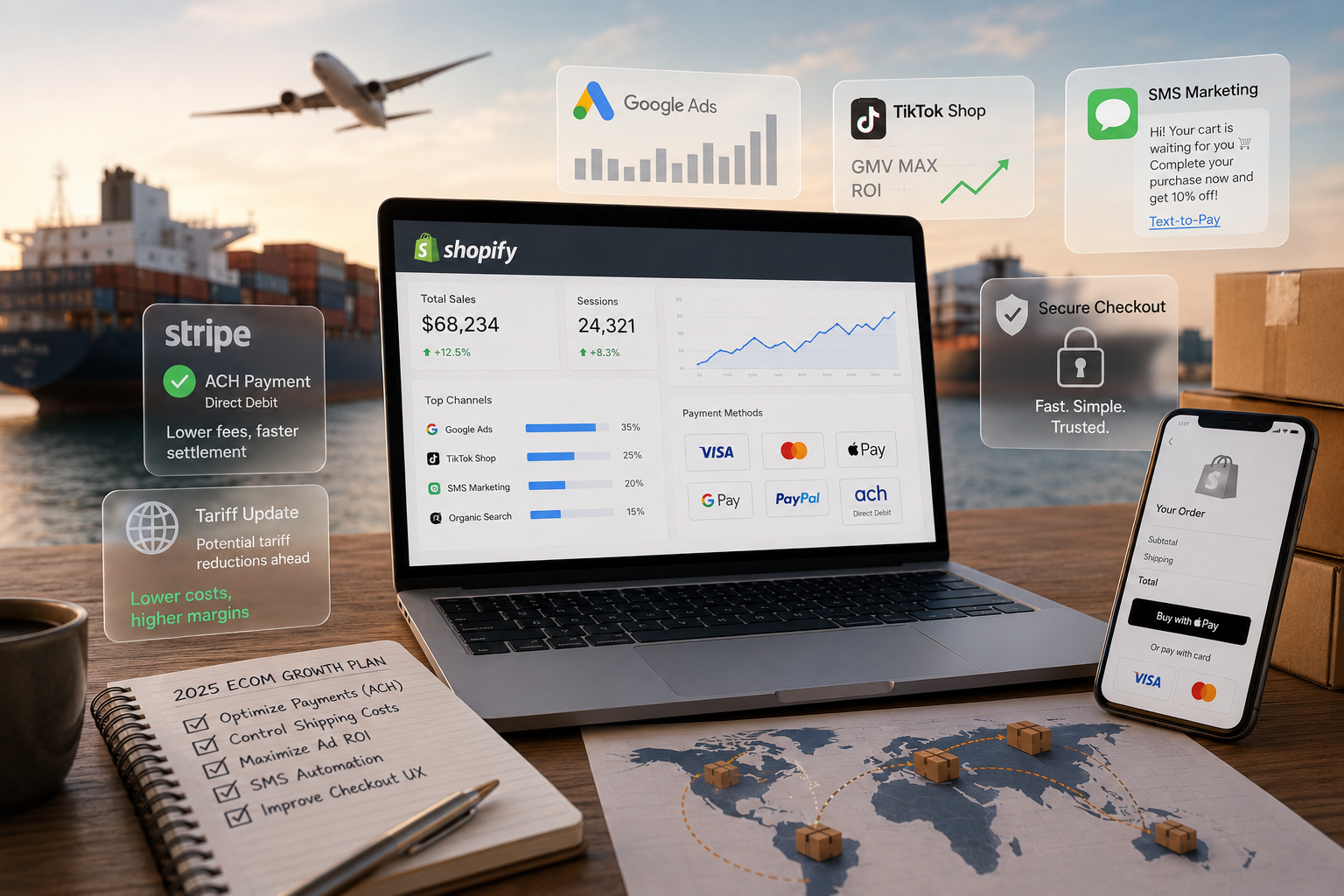
Daily Cross-Border E-Commerce Briefing | May 15, 2026 (Covering May 13–15 Releases)
1. Stripe Retires Legacy ACH Direct Debit API on May 15 — All Merchants Must Migrate to Payment Intents or Checkout Sessions
-
As of May 15, 2026, Stripe officially retired its legacy ACH Direct Debit API (the older Tokens, Charges, and Sources-based integration), requiring all merchants still using the legacy system to migrate to either the Payment Intents API or the Checkout Sessions API. The new APIs offer meaningful operational improvements over the legacy system: settlement speeds improve from T+6 days to T+4 (or T+2 with faster settlement), instant bank verification is available through Stripe Financial Connections, and Radar fraud prevention now covers ACH transactions — a capability that did not exist under the legacy system. Additionally, the new APIs support ACH processing in the EU and UK, not just the U.S., expanding geographic reach for merchants selling cross-border. This retirement is part of Stripe's broader Dahlia API modernization (version 2026-03-25), which also deprecated several Stripe.js methods including handleCardPayment, handleFpxPayment, and the legacy Sources API — all replaced by confirmCardPayment, confirmFpxPayment, and the Payment Methods API respectively.
For independent store owners and dropshippers who accept ACH payments — or who plan to offer ACH as a lower-cost alternative to credit card processing for B2B or high-ticket transactions — this retirement demands immediate verification. If your store uses a Stripe integration built before 2024, check with your developer or platform provider that the integration has been updated to the Payment Intents or Checkout Sessions API. The migration is not optional: legacy ACH transactions processed through the old API will fail after the May 15 cutoff. More broadly, the cost advantage of ACH over credit cards is significant — ACH fees typically run 0.8% capped at $5 versus 2.9% + $0.30 for cards — making ACH an attractive payment option for stores with average order values above $200. If you haven't yet enabled ACH as a checkout option, the post-migration new API environment is an excellent time to do so, particularly for stores selling to U.S. business buyers or wholesale customers who prefer bank-to-bank transfers.
Source: Stripe, Published on: May 15, 2026
2. Oil Prices Snap 3-Day Rally Ahead of Trump–Xi Summit; Strait of Hormuz Risks Persist
-
Brent crude traded at $105.76 per barrel and WTI at $101.14 as of mid-May 2026, with oil prices snapping a three-day rally just ahead of the highly anticipated Trump–Xi summit in Beijing. The Strait of Hormuz — through which roughly 25% of global seaborne oil passes — faces ongoing disruption from regional military conflict, and a UK-led coalition of over 40 nations has deployed naval assets including HMS Dragon, Typhoon jets, and autonomous mine-hunting systems to secure commercial shipping lanes. Hellenic Shipping News reports that Asia is bracing for a second wave of energy shocks, while Goldman Sachs analysts weighed in on whether the world risks running out of oil soon. The U.S. Federal Reserve's Goolsbee separately warned that the U.S. economy may be overheating amid inflation rising to 3.8% YoY — the biggest jump in over three years — adding further volatility to energy and input costs.
For independent online sellers and dropshippers, sustained high oil prices translate into cascading cost increases across the entire supply chain: higher product costs from factories paying more for energy, rising shipping rates across all modes, and ultimately higher fulfillment costs that erode already thin margins. Dropshippers selling heavier or bulkier items — where shipping cost is a larger share of the total order value — should audit their product catalog now and consider temporarily pausing high-shipping-cost SKUs or adjusting retail prices to reflect the new cost reality. For store owners running paid advertising, this is also a signal to tighten ROAS targets, since conversion rates may soften as consumers face higher gas prices ($4.53/gallon average in the U.S., up $1.35 YoY) and reduced discretionary spending power. Building a pricing buffer of 5–8% on advertised products now provides breathing room as costs continue to climb.
Source: Hellenic Shipping News, Published on: May 14, 2026
3. Google Ads Pre-GML Measurement Push: Journey-Aware Bidding, AI Max for Shopping, and Demand-Led Budget Pacing Roll Out
-
In a wave of announcements ahead of Google Marketing Live 2026 (scheduled for May 20), Google Ads rolled out several significant updates for ecommerce advertisers in early May. Journey-Aware Bidding — now in beta for Search campaigns using Target CPA — learns from both biddable and non-biddable conversion goals (phone calls, form submissions, newsletter signups, offline events) to optimize toward downstream revenue rather than only front-end micro-conversions. Smart Bidding Exploration, previously limited to Search, is expanding to Shopping campaigns and Performance Max with product feeds, with early data showing an average +27% increase in unique converting users. Demand-Led Budget Pacing allows Google's AI to automatically shift daily spend within a campaign's monthly budget — spending more on high-demand days and pulling back on slow ones — with campaign total budget adopters already seeing a 66% reduction in manual budget adjustments. Separately, AI Max for Shopping campaigns now supports text customization based on Merchant Center feed attributes, Final URL Expansion for intent-based landing page matching, and automatic format selection between text and Shopping ads.
For Shopify and WooCommerce store owners running Google Ads, these updates represent a fundamental shift from manual bid and budget management toward AI-orchestrated campaign optimization — but the quality of inputs determines the quality of outputs. Dropshippers and independent sellers should prioritize three actions immediately: first, ensure the Google Merchant Center product feed is impeccably structured with complete GTINs, accurate titles, and high-quality images, since AI Max for Shopping pulls directly from feed attributes to generate ad copy; second, implement enhanced conversion tracking to capture the full range of conversion signals (not just purchase events) that Journey-Aware Bidding requires; and third, test Demand-Led Budget Pacing on one campaign before rolling out broadly, monitoring whether the AI's spending pattern aligns with your actual sales cycle. With Google Marketing Live on May 20 likely to introduce further automation features, establishing clean data infrastructure now will pay compounding returns.
Source: Search Engine Roundtable, Published on: May 13, 2026
4. EZ Texting Launches in Shopify App Store, Bringing SMS Marketing Automation to 230,000+ Merchants
-
EZ Texting, an SMS marketing platform with over 230,000 existing customers, officially became available directly in the Shopify App Store on May 14, 2026. The integration enables Shopify merchants to automate SMS campaigns for abandoned cart recovery, order confirmations, shipping updates, new customer welcomes, and promotional broadcasts — all with pre-built workflow templates and AI-generated text features. A standout feature is the Text-to-Pay link capability, secured through Stripe, allowing customers to complete purchases directly from SMS messages without visiting the store. The platform cites data showing that 67% of consumers who subscribe to business text messages are more likely to make a purchase, and 89% check incoming texts within 15 minutes — dramatically outperforming email open rates, which have declined to roughly 21% across ecommerce.
SMS marketing represents one of the highest-ROI channels available to dropshipping stores today, particularly for recovering abandoned carts — the single largest source of lost revenue for most independent stores. With cart abandonment rates typically ranging from 60% to 80% in ecommerce, even a modest SMS recovery sequence can generate a meaningful revenue uplift. Dropshippers should prioritize setting up a three-message abandoned cart SMS flow: a reminder within 30 minutes, a social-proof or urgency message at the 2-hour mark, and a final discount-incentive message at 24 hours. The Text-to-Pay feature is especially valuable for stores selling impulse-purchase or lower-ATC items, as it removes the friction of returning to the site to complete checkout. When implementing, ensure SMS compliance with TCPA and GDPR requirements — obtaining explicit opt-in consent is non-negotiable and protects against costly legal exposure.
Source: The AI Journal, Published on: May 14, 2026
5. TikTok Shop Overhauls GMV Max ROI Calculation to Factor In Seller Costs, Reshaping Campaign Profitability Metrics
-
On May 14, 2026, TikTok Shop updated its GMV Max advertising product to factor in affiliate commissions, discount coupons, and platform fees when calculating return on investment — a significant departure from the previous methodology that measured returns against gross transaction value alone. Under the old system, campaigns relying heavily on affiliate creators or coupon-driven promotions appeared more profitable than they actually were on a net basis, since seller-side costs were excluded from ROI reporting. The new calculation deducts these costs before reporting campaign performance, providing sellers with a more accurate picture of net profitability. This change coincides with TikTok Shop's broader May 2026 algorithm overhaul, which shifted ranking signals from entertainment-weighted metrics (likes, shares, follows) to commerce-weighted signals (product page clicks, add-to-cart events, and purchases), meaning videos with high engagement but zero sales now lose distribution priority.
For dropshippers and independent store owners using TikTok Shop as a sales channel, this GMV Max update requires an immediate recalibration of campaign performance benchmarks. Campaigns that previously appeared to be generating 3x–5x ROAS may, under the new net calculation, show 2x–3x or lower — not because performance changed, but because the math now reflects actual take-home revenue. Sellers should audit all active GMV Max campaigns, compare old versus new ROI figures, and adjust daily budgets accordingly. The algorithm shift toward commerce signals also means that product-focused content — demonstrations, unboxings, and comparison videos — will now outperform purely entertaining content that lacks a clear purchase call-to-action. For stores operating on thin dropshipping margins, testing TikTok's official shipping labels (available as low as $2.99 versus $3.60+ for alternative carriers) can offset some of the new cost visibility while maintaining delivery performance metrics that the algorithm increasingly rewards.
Source: The Keyword, Published on: May 14, 2026
6. Shein Sues Temu in UK Court Over Mass Copyright Infringement of Product Photos
-
Fast-fashion giant Shein filed a lawsuit against rival Temu in a UK court on May 14, 2026, accusing the platform of illegally lifting thousands of copyrighted product photographs from Shein's website to advertise copycat products on Temu's marketplace. Temu has responded by arguing that it is not legally responsible for third-party seller images uploaded to its platform and has accused Shein of pursuing the litigation primarily for competitive advantage rather than genuine intellectual property protection. The case, reported by MLex, marks a significant escalation in the long-running legal battles between the two Chinese-founded ultra-fast-fashion platforms, both of which have been rapidly expanding their UK and European market presence. The lawsuit comes as both companies face mounting regulatory pressure: the EU is moving to abolish the €150 duty-free de minimis threshold for non-EU shipments starting July 2026, and French authorities recently reported that 46% of analyzed items from such platforms failed safety standards.
This lawsuit highlights a growing risk for dropshippers who rely on supplier-provided product images without verifying their provenance. If a supplier's product photo was originally sourced from a competitor's listing — whether from Shein, an Amazon seller, or another brand — the dropshipper using that image on their own store could face copyright infringement claims, DMCA takedown notices, or even litigation. Independent store owners should immediately audit their product image libraries: reverse-image-search top-selling products using Google Lens or TinEye, replace any images that trace back to competitor listings, and invest in original product photography or AI-generated lifestyle images where feasible. For stores operating in the UK and EU markets specifically, where intellectual property enforcement is becoming more aggressive, this is not a theoretical risk — it is a compliance requirement that directly affects store longevity and payment processor standing.
Source: MLex, Published on: May 14, 2026
7. Trump and Xi to Weigh Tariff Cuts on $30 Billion of Imports in Managed Trade Push at Beijing Summit
-
U.S. President Donald Trump and Chinese President Xi Jinping met in Beijing on May 14–15, 2026, for the first visit by a sitting U.S. president to China in nearly a decade. At the center of the agenda: a "Board of Trade" proposal advanced by U.S. Trade Representative Jamieson Greer, under which each side would identify approximately $30 billion worth of goods — potentially expanding to $50 billion — on which tariffs could be reduced. Key sectors under discussion include energy (crude oil, LNG, coal), agriculture (soybeans, beef), and consumer goods (electronics, footwear). The current tariff landscape features China's 10% general extra tariff on all U.S. imports plus retaliatory duties of 10–55% on specific goods, while the U.S. maintains 7.5% tariffs on a raft of Chinese consumer products dating from 2019 and a temporary 10% global tariff set to expire in July 2026. Bilateral trade has shrunk 29% to $415 billion from its 2024 peak of $582 billion, with the U.S. deficit falling roughly 32% to $202 billion — the lowest in two decades. A heavyweight CEO delegation including Elon Musk (Tesla/SpaceX), Tim Cook (Apple), and Jensen Huang (Nvidia) accompanied Trump, underscoring deep corporate stakes despite years of "decoupling" rhetoric.
For dropshippers and independent ecommerce store owners — particularly those sourcing products from Chinese manufacturers and selling into the U.S. market — the Trump–Xi summit represents the most consequential trade policy moment of 2026. Tariff reductions on consumer goods categories would directly improve landed costs and gross margins, potentially reversing some of the margin compression that has squeezed dropshipping profitability over the past two years. Sellers should monitor the specific product categories included in any tariff relief package and be prepared to adjust pricing, ad spend, and inventory strategy quickly once details are released. Conversely, if negotiations stall and the existing 10% global tariff is extended beyond its July 2026 expiration, costs will remain elevated. A practical near-term step: identify which products in your catalog fall under current tariff lines, calculate the margin impact of both a tariff reduction (bull case) and a tariff extension (bear case), and prepare two distinct pricing and sourcing scenarios so you can move immediately once the policy direction becomes clear.
Source: Zawya, Published on: May 14, 2026
8. As AI Reshapes Product Discovery, the Checkout May Become the Defining Brand Experience of 2026
-
A landmark Accenture survey of over 18,000 consumers, released in May 2026, reveals that 72% of consumers now use generative AI regularly, and AI has become the #2 product recommendation channel — behind only physical stores and ahead of social media and friends/family. Crucially, 74% of consumers say they would rather receive no offer than an irrelevant one, and nearly two-thirds would abandon a purchase if the checkout process becomes cluttered. As AI agents increasingly intermediate the product discovery journey, The Drum reports that the checkout moment is becoming the most strategically important brand-owned surface in ecommerce — the one point where a brand can still directly shape the customer experience rather than yielding it to an algorithm. A separate Checkout.com study found that 97% of consumers want "invisible" payments, and 50% are ready to let AI agents shop on their behalf, though 55% cite privacy concerns as a barrier. Meanwhile, U.S. retail sales data for April 2026 showed online retailers up 1.1% month-over-month, bucking a broader slowdown where overall retail grew just 0.5% as gas prices squeezed discretionary spending.
For independent Shopify and WooCommerce store owners, the AI-mediated shopping trend demands a dual focus on product data quality and checkout experience optimization. First, product feeds must be structured so that AI agents — whether Google's AI Mode, ChatGPT, or platform-native shopping assistants — can accurately index and recommend your products. This means complete, structured product data including GTINs, detailed attributes, and clear category hierarchies. Second, the checkout flow itself becomes your primary brand differentiator: a clean, fast, single-page checkout with multiple payment methods (Shop Pay, PayPal, Stripe, Apple Pay, Google Pay) and transparent shipping costs is no longer a nice-to-have but a conversion requirement. Dropshippers should test their checkout flow on mobile devices weekly, aiming for under 15 seconds from cart to confirmation, and remove every non-essential form field, upsell popup, or distraction that could trigger the "cluttered checkout" abandonment that the Accenture data warns against.
Source: The Drum, Published on: May 14, 2026