Daily Cross-Border E-Commerce Briefing | May 18, 2026 (Covering May 15–18 Releases)
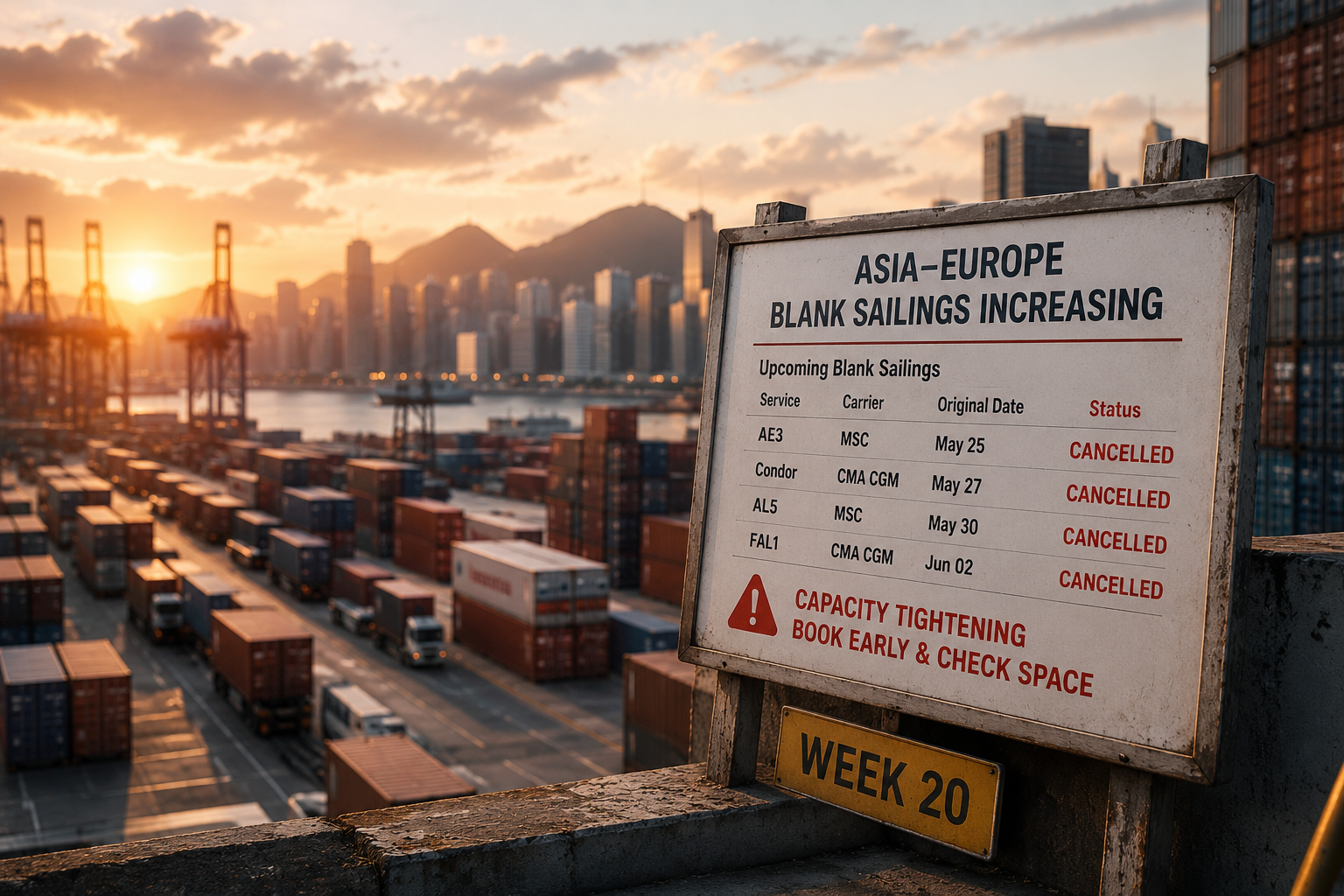
1. Advanced Shipping and Trading Week 20 Report: Blank Sailings Rise as Carriers Manage Asia-Europe Capacity
-
Advanced Shipping and Trading S.A. published its Weekly Shipping Market Report for Week 20 of 2026 on May 16, 2026, with a focus on capacity management strategies being deployed by major ocean carriers on the Asia-Europe trade. The report documents a notable increase in blank sailing announcements for late May and early June, with carriers including MSC and CMA CGM withdrawing scheduled departures on Asia-North Europe and Asia-Mediterranean services. Blank sailings reduce available capacity on a given trade lane, which typically supports rate levels by preventing oversupply. The report also notes that the Premier Alliance has restructured its transatlantic services, separating the MS2 service into two distinct loops — one Asia-Mediterranean (MD2) and one Middle East-US (GS2) — to enable ONE to redeploy Chinese-built vessels more efficiently given current geopolitical routing constraints. Fuel costs remain a significant variable, with bunker prices elevated due to the ongoing Middle East conflict.
For dropshipping sellers who use sea freight for any part of their supply chain — including bulk shipments to prep centers or consolidation hubs — the blank sailing announcements mean that booking lead times are extending. If you were planning to ship goods from Asia to Europe in late May or early June, contact your freight forwarder now to confirm space availability, as blank sailings can cause vessels to fill up faster than expected. The restructuring of carrier alliances also means that transit times on some lanes may change; verify your expected delivery windows with your forwarder rather than relying on historical schedules. For dropshippers operating purely on a direct-from-supplier model with no sea freight exposure, monitor whether your suppliers are experiencing any outbound capacity constraints that could affect their ability to fulfill orders on time.
Source: Hellenic Shipping News, Published on: May 16, 2026
2. Google Officially Announces AI-Powered Bidding and Budgeting Tools for Search and Shopping Campaigns
-
Google's official Ads and Commerce Blog published the full details of its new AI-powered bidding and budgeting tools on May 18, 2026, confirming the rollout of Journey-Aware Bidding, Smart Bidding Exploration for Shopping and Performance Max, and a new demand-led budget pacing system. The official announcement confirms that Journey-Aware Bidding is entering beta for Search campaigns using Target CPA, with the system designed to connect online ad interactions to downstream conversion events — including phone calls, in-store visits, and repeat purchases — giving Smart Bidding a richer signal set to optimize against. The budget pacing update is particularly significant: Google's system will now shift spend toward high-demand windows within a day, meaning advertisers no longer need to manually adjust dayparting schedules to capture peak conversion periods. Google also confirmed that these tools are designed to work within existing campaign structures, requiring no migration to new campaign types.
Independent Shopify and WooCommerce store owners running Google Shopping ads should pay close attention to the Smart Bidding Exploration expansion. This feature allows Google to test your product listings against queries and audiences that your current targeting does not explicitly cover — effectively acting as an automated discovery layer for new customer segments. For dropshipping sellers with broad product catalogs, this can surface demand you did not know existed. The key risk is budget leakage into low-quality traffic, so monitor your search term reports and conversion rates closely during the first two to three weeks after enabling the feature, and set a conservative target ROAS to keep the exploration within profitable bounds.
Source: Google Ads Blog, Published on: May 18, 2026
3. Amazon Ads Launches Global Benchmarks Reporting Across 18 Markets on May 18 — MMM API and GIA Also Reach GA
-
Amazon Ads announced on May 18, 2026, that its benchmarks reporting feature is now generally available across all 18 supported marketplaces, including the United States, Canada, Mexico, Brazil, Australia, Japan, the United Kingdom, Germany, France, Italy, Spain, the Netherlands, Sweden, Poland, Saudi Arabia, the UAE, India, and Egypt. Benchmarks reporting allows advertisers to compare their campaign performance metrics — including click-through rates, conversion rates, and cost-per-click — against anonymized aggregate data from other advertisers in the same product category and marketplace. In the same announcement, Amazon confirmed that its Marketing Mix Modeling (MMM) API has exited beta and is now generally available in 14 markets, enabling brands to programmatically access advertising and retail signals for use in external MMM solutions. The Generative Image Automation (GIA) tool, which uses AI to generate lifestyle product images for Sponsored Brands ads, also reached general availability on the same date.
For dropshipping sellers advertising on Amazon, the global benchmarks rollout is a practical tool for diagnosing whether your campaign performance is competitive or lagging. If your Sponsored Products click-through rate is below the category benchmark, that signals a product image or title issue rather than a bidding problem. If your conversion rate is below benchmark despite strong CTR, the issue is likely on the product detail page — pricing, reviews, or bullet points. Use the benchmarks data to prioritize where to focus optimization effort. The GIA tool is also worth exploring for dropshippers who lack professional product photography: it can generate contextual lifestyle images from your existing product shots, which can improve Sponsored Brands ad performance without requiring a photoshoot.
Source: PPC Land, Published on: May 18, 2026
4. Xeneta Weekly Update: Far East to US West Coast Spot Rates Remain 50%+ Above Pre-Conflict Levels
-
Xeneta's weekly ocean container shipping market update published on May 15, 2026, reports that average spot rates from the Far East to the US West Coast remain more than 50% above pre-conflict levels recorded at the end of February 2026, when the Iran conflict began disrupting Middle East shipping corridors. While rates have remained broadly flat over the past month — suggesting the initial shock has been absorbed — they have not retreated, and Xeneta analysts note that the structural factors driving elevated rates (reduced effective capacity due to rerouting, higher fuel costs, and carrier surcharge discipline) remain in place. The Xeneta Shipping Index (XSI-C) shows that contract rates are also elevated, meaning importers who locked in annual contracts earlier in 2026 are paying above historical norms. Asia-US East Coast rates have shown slightly more volatility, with West Coast prices at approximately $2,828 per FEU for the week ended May 8, up 4% from the prior week.
For dropshipping sellers shipping individual orders directly from Asian suppliers to US customers via air freight, the ocean freight rate environment is a useful reference point: it confirms that the overall cost of moving goods from Asia to the US is structurally elevated, which means your air freight rates are unlikely to fall significantly in the near term. If you are currently absorbing shipping costs as part of your offer (free shipping to customers), review whether your product pricing still supports this at current freight rates. Sellers who have not updated their shipping cost assumptions since early 2026 should recalculate their margins using current carrier quotes. A 50% increase in ocean rates typically translates to a 15–25% increase in air express rates on the same lanes over the same period.
Source: Hellenic Shipping News, Published on: May 16, 2026
5. Container Freight Markets Mixed in Week 20 — Transpacific Holds Firm While Asia-Europe Rates Diverge
-
Container freight markets were mixed during Week 20 of 2026 (May 12–18), according to the weekly container report published by Hellenic Shipping News. The Freightos Baltic Index showed continued divergence across the main east-west trade lanes, with the FBX13 index tracking China and East Asia to Mediterranean routes strengthening sharply, rising $480 week-on-week to $3,933 per FEU — continuing to outperform North Europe lanes. Transpacific rates remained broadly stable to slightly higher, with Asia-US West Coast prices holding above pre-Iran-conflict levels. The Lion Shipbrokers Weekly Market Report for Week 20, published May 16, 2026, noted that while spot rate momentum has slowed compared to the sharp spikes seen in earlier weeks, carriers continue to layer peak-season surcharges and emergency fuel surcharges, keeping effective all-in rates elevated. The Advanced Shipping and Trading weekly report for the same week confirmed that capacity on key Asia-Europe lanes remains constrained, with blank sailings announced by several major carriers for late May and early June.
For dropshipping sellers who source products from China, South Korea, or Southeast Asia and ship to European customers, the elevated Asia-Mediterranean rates are a direct cost pressure. If your fulfillment model involves any sea freight component — even for bulk replenishment to a European prep center — the current $3,933/FEU rate on the China-Mediterranean lane is approximately 20–25% higher than the same period last year. Review your landed cost calculations and consider whether your current retail pricing still supports adequate margins. For sellers using air freight to fulfill individual orders directly to European customers, the sea freight spike is less directly relevant, but it signals broader supply chain tightness that can affect supplier lead times and product availability.
Source: Hellenic Shipping News, Published on: May 16, 2026
6. Lion Shipbrokers Week 20 Report: Carrier Surcharges Accumulate as Peak Season Approaches
-
Lion Shipbrokers published its Weekly Market Report for Week 20 of 2026 on May 16, 2026, providing a detailed assessment of container shipping market conditions across major trade lanes. The report highlights that ocean carriers have been systematically stacking surcharges — including Emergency Fuel Surcharges (EFS), Peak Season Surcharges (PSS), and War Risk Surcharges on Middle East-adjacent routes — creating a compounding effect on all-in freight costs that is not fully captured by headline spot rate indices. MSC, CMA CGM, and Maersk have all announced revised Freight All Kinds (FAK) rates for Far East to European and Mediterranean destinations effective in late May and early June 2026. The report also notes that containership time-charter rates have reached new records, reflecting shipowner confidence that elevated demand will persist through the peak season. Blank sailing announcements for the Asia-Europe trade are increasing, which is expected to tighten available capacity further in the coming weeks.
Dropshipping sellers who rely on suppliers to manage outbound shipping should request updated freight quotes from their suppliers now, as the surcharge stacking described in this report means that quotes from two to three weeks ago may no longer be accurate. If your supplier quotes on a CIF basis, the all-in cost to your destination port has likely increased by 10–20% since early May. For sellers who are considering switching from air to sea freight to reduce costs, the current sea freight environment — with multiple surcharges on top of base rates — may narrow the cost advantage more than expected. Build a full landed cost model that includes base rate, EFS, PSS, and any applicable war risk surcharges before making a mode-of-transport decision.
Source: Hellenic Shipping News, Published on: May 16, 2026