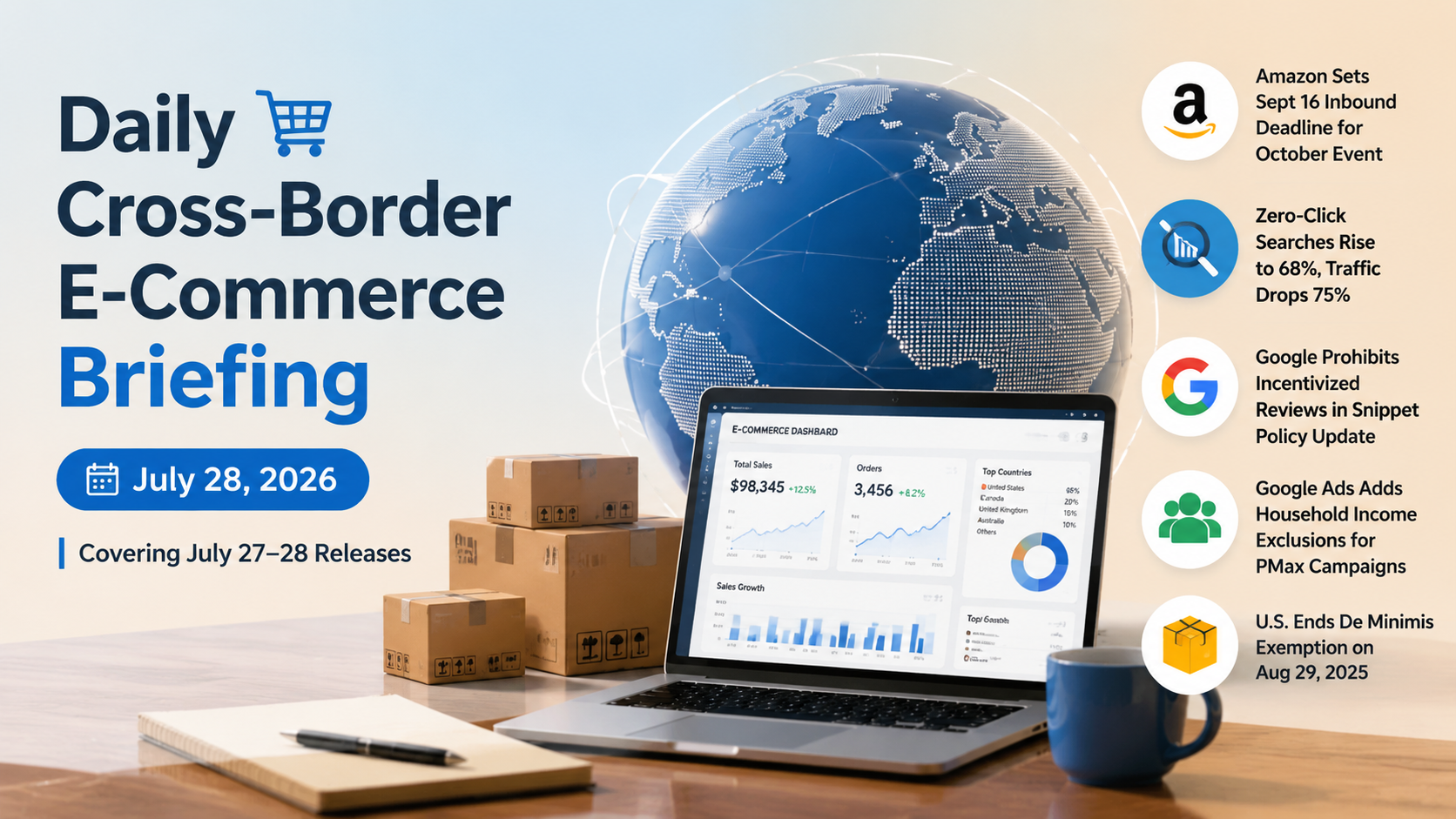
Daily Cross-Border E-Commerce Briefing | July 28, 2026 (Covering July 27–28 Releases)
1. Amazon Establishes September 16 Inbound Cargo Deadline for October Promotion Event
-
Amazon has announced a September 16 inbound cargo deadline for an unannounced October promotional shopping event. Released in a merchant bulletin on July 27, 2026, the scheduling directive applies to all sellers seeking Prime promotion eligibility. The platform requires that holiday promotion inventory arrive at fulfillment facilities before the mid-September cutoff date. Amazon explained that the early deadline prevents logistic bottlenecks and ensures product availability during high-volume sales events. Merchants who miss the shipping deadline risk having their holiday promotional listings deactivated or restricted.
For dropshipping stores utilizing Amazon fulfillment options or managing custom products, this logistics schedule requires early coordination. Dropshippers should communicate with suppliers immediately to schedule holiday shipments well before the September 16 deadline. Confirm that your supply partners can prioritize assembly and shipping to avoid warehouse processing delays. Use this lead time to verify inventory levels for your high-performing Shopify or WooCommerce listings. Preparing your logistics operations early protects your storefront from delivery disruptions and ensures stable holiday sales.
Source: PPC Land, Published on: July 27, 2026
2. Website Traffic Drops Seventy-Five Percent as Zero-Click Searches Rise to Sixty-Eight Percent
-
A publisher case study reveals that a popular directory website has lost seventy-five percent of search traffic as zero-click searches hit sixty-eight percent. Published on July 27, 2026, the traffic analysis details how AI search summaries answer user queries directly. The study shows that sixty-eight percent of mobile search queries now end on Google's dashboard without a site visit click. Consequently, the directory site experienced a massive decline in organic visitor referrals over the last two quarters. The publisher called for industry updates to search tracking tools to measure conversational summary exposure.
For dropshippers relying on search marketing to drive visitors to Shopify storefronts, this zero-click trend requires content strategy updates. Dropshippers should focus on creating detailed product guides that provide deep value beyond simple factual summaries. Structure your storefront blog posts to target commercial intent keywords that lead directly to checkout pages. Build strong brand loyalty through email marketing and social media channels to reduce reliance on search engines. Diversifying your visitor acquisition channels ensures that your store maintains consistent sales regardless of search platform updates.
Source: PPC Land, Published on: July 27, 2026
3. Google Ads Update Review Snippets Policy to Prohibit Incentivized Customer Feedback
-
Google has updated its review snippets policy guidelines to prohibit fake or undisclosed incentivized customer reviews. Released in a developer bulletin on July 27, 2026, the policy rules apply to all structured review markup listings. The updated guidelines require webmasters to label reviews that were generated through customer discounts or promotional gifts. Google explained that undisclosed incentives mislead searchers and degrade the reliability of structured snippet results. The platform will automatically deactivate review snippet rich results for domains that violate the disclosure rules.
For dropshippers utilizing customer review widgets to display star ratings on Shopify product pages, this update requires compliance audits. Dropshippers must check their review collection software to ensure it complies with Google's updated disclosure rules. Clearly mark any reviews that were collected through discount offers or promotional gift exchanges on your site. Avoid using deceptive review plugins that display fake customer feedback to prevent search engine indexing penalties. Providing honest, compliant reviews builds long-term customer trust and protects your organic search placements.
Source: Search Engine Roundtable, Published on: July 27, 2026
4. Google Ads Adds Household Income Exclusions for Performance Max Campaigns
-
Google Ads has introduced household income exclusions for Performance Max campaigns to improve targeting control for advertisers. Spotted in active dashboard setups on July 27, 2026, the targeting update allows advertisers to exclude specific demographic brackets. The update enables marketers to prevent ads from displaying to low-income user segments during automated auctions. Google designed the feature to reduce ad spend waste on demographics that are unlikely to convert. The household income targeting settings are now rolling out to all advertising accounts globally this week.
For dropshippers selling premium or luxury items on Shopify storefronts, this targeting update allows better ad budget allocation. Dropshippers should review active Performance Max campaigns and exclude lower household income brackets to focus budgets on high-value buyers. This targeting adjustment prevents your ad spend from being wasted on clicks that do not lead to sales. Monitor your average order value metrics after applying the exclusions to verify the impact on storefront margins. Refining your demographic targeting helps independent brands maximize ad performance and boost store profitability.
Source: Search Engine Roundtable, Published on: July 27, 2026
5. Google Ads Updates Conversion Measurement Documentation detailing Data Processing Times
-
Google Ads has updated its conversion measurement support documentation to detail data processing times and collection sources. Published on July 27, 2026, the updated guide outlines how long the ad platform takes to register purchase events. The documentation explains that web conversions can take up to twenty-four hours to display inside ad reports. Google details how the system integrates offline data uploads with online user tracking logs to attribute campaign conversions. The updated documentation aims to help marketers troubleshoot reporting delays and configure tracking pixels correctly.
For dropshippers monitoring daily campaign performance to adjust ad bids, this updated documentation provides crucial baseline timing details. Dropshippers should wait at least twenty-four hours before making major campaign budget adjustments based on reported conversion metrics. Verify that your Shopify conversion tracking configurations align with the data import paths explained in Google's guide. Avoid panic-pausing active ad sets due to temporary reporting delays in your Google Ads manager console. Understanding conversion latency helps independent sellers make data-driven optimization decisions and avoid wasted ad spend.
Source: Search Engine Roundtable, Published on: July 27, 2026
6. ChatGPT Ads Manager Releases Budget Modification Rules and Conversational API Updates
-
OpenAI's ChatGPT Ads Manager has released new budget modification rules and conversational application programming interface updates. Announced in an engineering log on July 27, 2026, the update introduces daily budget pacing controls for conversational ads. The updated API enables developer platforms to adjust campaign target bids programmatically based on real-time chat volume. OpenAI explained that the features aim to prevent budget exhaustions during periods of high searcher interaction. The updated developer API tools are currently available for all certified ad integration partners.
For dropshippers utilizing automated campaign software to scale sales on conversational search networks, this API update improves budget security. Dropshippers should ensure their ad management software is updated to integrate OpenAI's new budget pacing controls. The pacing controls prevent your daily ad budget from being spent too quickly during morning chat traffic spikes. Adjust your API bid rules to scale spending during high-volume shopping hours on the chat assistant network. Utilizing automated budget controls helps independent sellers manage ad spends efficiently and protect storefront margins.
Source: Search Engine Roundtable, Published on: July 27, 2026
7. Google Ads Editor Version Two Point Thirteen Rolls Out with Campaign Asset Updates
-
Google has released Ads Editor version two point thirteen to simplify offline campaign management for digital marketing professionals. Announced in a product update on July 27, 2026, the updated software utility is now available for download. The version update supports bulk editing for shopping campaign assets and expands local service targeting options offline. Google explained that the release fixes several bugs related to asset group upload errors in Performance Max campaigns. The company advised all desktop users to upgrade to the latest editor version to ensure database compatibility.
For dropshippers managing large product feeds across multiple Shopify stores, this Ads Editor update simplifies bulk campaign edits. Dropshippers should download version two point thirteen to perform offline changes to product titles and descriptions before publishing campaigns. Use the bulk editor to apply identical targeting exclusions across all your active Performance Max ad groups. This offline editing utility saves hours of manual configuration compared to using the online browser interface. Upgrading your editor software helps independent sellers manage complex ad groups with higher speed and fewer errors.
Source: Search Engine Roundtable, Published on: July 27, 2026
8. Research Reveals Seventy-Five Percent of Advertisers Lose Ad Budget to Bot Traffic
-
A research study by Lunio reveals that seventy-five percent of advertisers lose digital ad budgets to automated bot traffic. Published on July 27, 2026, the advertising analysis indicates that only five percent of agencies use invalid traffic tools. The study details that automated search bots and fake accounts click display ads, inflating campaign costs for merchants. The report estimates that digital advertisers lose billions of dollars annually due to unmonitored invalid traffic sources. Researchers advised brand managers to implement third-party verification filters to block invalid clicks on search networks.
For dropshipping stores running search campaigns to drive buyers to Shopify catalogs, this click fraud study highlights security needs. Dropshippers should review their ad click logs to identify potential spikes in suspicious traffic from single IP addresses. Consider implementing third-party invalid traffic protection tools to automatically block bot clicks on your search display ads. Set up strict geographic exclusions in your ad groups to avoid traffic from known bot farm locations. Protecting your ad budget from fake clicks ensures that your digital spending drives real buyers to your store.
Source: PPC Land, Published on: July 27, 2026