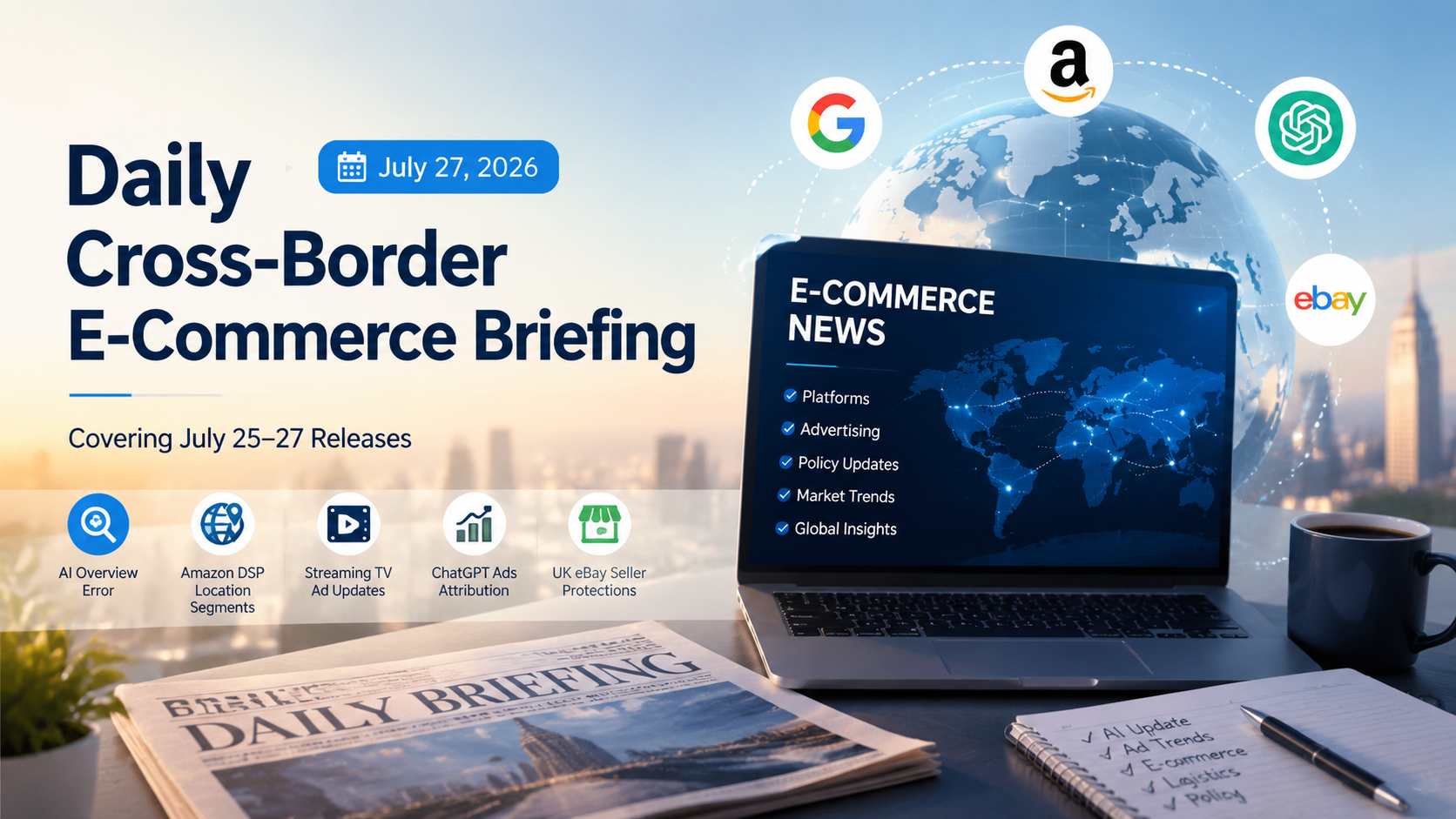
Daily Cross-Border E-Commerce Briefing | July 27, 2026 (Covering July 25–27 Releases)
1. Google AI Overview Failure Forces Local Bakery to Deny Fake Closing Announcements
-
A Google AI Overview error has forced a local bakery to issue public denials regarding a fake closing announcement. Spotted on July 26, 2026, the search summary incorrectly stated that the business would close permanently on July 31. The generative summary pulled outdated information from a public social forum posted by customers years prior. The business owner reported that the incorrect search listing led to a seventy percent drop in weekend reservations. Google's support team confirmed they resolved the specific search display error and are auditing the algorithmic indexing process.
For dropshipping storefronts relying on Google Search visibility to attract buyers to Shopify pages, this AI overview error highlights verification risks. Dropshippers should audit how their business name and product availability display in conversational search features. Monitor public social forums and review platforms to ensure outdated threads do not populate search summaries. Submit immediate feedback reports through search property consoles if you spot incorrect announcements regarding your brand. Proactive brand monitoring ensures that automated search summaries do not disrupt customer trust or storefront sales.
Source: PPC Land, Published on: July 26, 2026
2. Amazon DSP Gains Location Segments for Campaign Targeting Across Six Markets
-
Amazon Demand Side Platform has integrated new location segments to expand target options across six international markets. Announced on July 26, 2026, the target integration allows advertisers to use geographic data partner segments in active campaigns. The location segments are now available to campaign managers in the United States, the United Kingdom, and four additional European regions. Amazon confirmed that the geographical targeting updates help brands deliver advertising campaigns based on real-time foot traffic data. The target database updates are now live inside all active DSP campaign manager accounts.
For dropshippers operating regional distribution models or focusing campaigns on high-converting zones, this location targeting update improves efficiency. Dropshippers should adjust their DSP display ads to target buyers in regions where delivery times are fastest. Use the localized location segments to run campaigns during peak shopping hours in specific metropolitan centers. Focus your ad spend on areas where consumer demand for your Shopify products is historically strongest. Implementing precise geographic targeting helps independent sellers reduce ad budget waste and optimize return on investment.
Source: PPC Land, Published on: July 26, 2026
3. Amazon Adjusts Streaming TV Ad Formats and Releases Generative Design Features
-
Amazon has modified its streaming television advertising formats while releasing ten new artificial intelligence design features for brands. Confirmed in a developer bulletin on July 26, 2026, the update removes single-deal purchasing options for streaming campaigns. Instead, advertisers must utilize programmatic ad networks to purchase video inventory across Prime Video placements. Concurrently, the platform has released ten automated video creation tools to help merchants compile high-resolution advertising graphics. The format changes and design tools will apply to all advertising accounts starting next month.
For dropshippers utilizing video ads to drive brand traffic to Shopify storefronts, this update provides advanced creation resources. Dropshippers should leverage Amazon's new video design features to construct high-quality promotional ads without hiring expensive designers. Test the programmatic video placements to capture buyer attention on streaming devices during holiday sales campaigns. Avoid relying on manual single-deal ad purchases to keep your video campaign management efficient. Utilizing automated video design features allows independent sellers to scale brand marketing efforts with lower production budgets.
Source: PPC Land, Published on: July 26, 2026
4. ChatGPT Ads Manager Gains App Attribution Integration in Seven Markets
-
OpenAI's ChatGPT Ads Manager has gained mobile app attribution integrations across seven international markets. Published in a partner update on July 26, 2026, the tracking console now supports third-party measurement integrations. The update allows advertisers to connect active attribution accounts to measure download volumes and purchase conversion events. The attribution feature is currently live for mobile campaigns running in North American and European marketing regions. OpenAI confirmed that the integration helps mobile developers measure customer acquisition metrics during conversational search sessions.
For dropshippers operating proprietary mobile store apps or utilizing mobile ads to promote Shopify catalogs, this integration improves tracking. Dropshippers should link their store attribution pixels to ChatGPT Ads Manager to track mobile purchase conversions accurately. Use this mobile attribution data to identify which customer segments generate the highest value from chat queries. Focus your ad spend on high-converting mobile placements that drive direct downloads and repeat orders. Implementing unified mobile tracking helps independent sellers measure conversational marketing campaigns with higher precision.
Source: PPC Land, Published on: July 26, 2026
5. YouTube Releases Shorts Thumbnail Editing but Blocks Automated AB Testing
-
YouTube has ended a two-year wait by releasing thumbnail editing tools for Shorts video creators. Announced in a creator bulletin on July 26, 2026, the mobile update allows uploaders to select custom cover frames. However, the platform has blocked automated A/B testing options for Shorts thumbnails to prevent database performance overload. The product team explained that thumbnail A/B testing remains restricted to standard long-form video uploads. Uploaders can adjust mobile thumbnail covers manually during the video publishing process starting this week.
For dropshippers utilizing YouTube Shorts to showcase product demonstrations and drive organic traffic, this update improves click rates. Dropshippers should design high-impact thumbnail frames that display product benefits clearly to viewers browsing Shorts feeds. Perform manual thumbnail testing by changing cover images weekly and monitoring organic traffic changes on Shopify pages. Avoid using default video frames that fail to capture customer attention in busy video feeds. Optimizing your video cover presentations helps independent sellers increase organic referral traffic and boost product visibility.
Source: PPC Land, Published on: July 26, 2026
6. Google Signs European Union AI Code Ahead of Strict Turnover Fines
-
Google has signed the European Union AI code of conduct as advertisers prepare for strict turnover fines starting August 2. Released on July 26, 2026, the voluntary agreement commits the company to implementing safety checks for generative features. The regulatory framework mandates disclosures for AI content and restricts specific automated targeting practices in European regions. Non-compliant business entities risk fines of up to three percent of global annual turnover under the new law. Google explained that signing the code helps align its search platforms with upcoming regulatory enforcement guidelines.
For dropshippers running automated ad campaigns targeting European consumers, this regulatory update requires a compliance audit. Dropshippers should verify that their product landing pages and ad copy comply with European AI disclosure guidelines. Ensure your automated customer chat assistants state clearly that they utilize generative technology to avoid compliance issues. Monitor your European ad delivery metrics during the transition phase to identify if targeting restrictions impact acquisition costs. Adhering to regional compliance rules protects your independent brand from severe advertising account blocks.
Source: PPC Land, Published on: July 26, 2026
7. Google Search Ranking Volatility Spikes Over the July Twenty-Four Weekend
-
Google Search ranking volatility has spiked significantly over the weekend of July 24, 2026, causing fluctuations in organic traffic. Confirmed by search tracking sensors on July 26, 2026, the ranking turbulence indicates an unannounced search core update is active. Webmasters reported sudden rank shifts for key e-commerce keywords and product directory search pages. The volatility has impacted both informational blogs and retail storefronts across diverse international market segments. Google has not confirmed any official search algorithm update and maintains that search tweaks happen continuously.
For dropshippers tracking organic search traffic to Shopify or WooCommerce store pages, this weekend volatility requires careful review. Dropshippers should check their Google Analytics dashboards to see if their main product keywords experienced ranking shifts. Avoid making sudden website layout changes or modifying page URL structures during periods of active ranking turbulence. Focus on monitoring conversion rates to verify if traffic changes impact your overall store sales volume. Keeping a steady SEO strategy during algorithm updates helps independent sellers maintain long-term search placement.
Source: Search Engine Roundtable, Published on: July 26, 2026